
How to Choose the Perfect Treatment Room for Rent
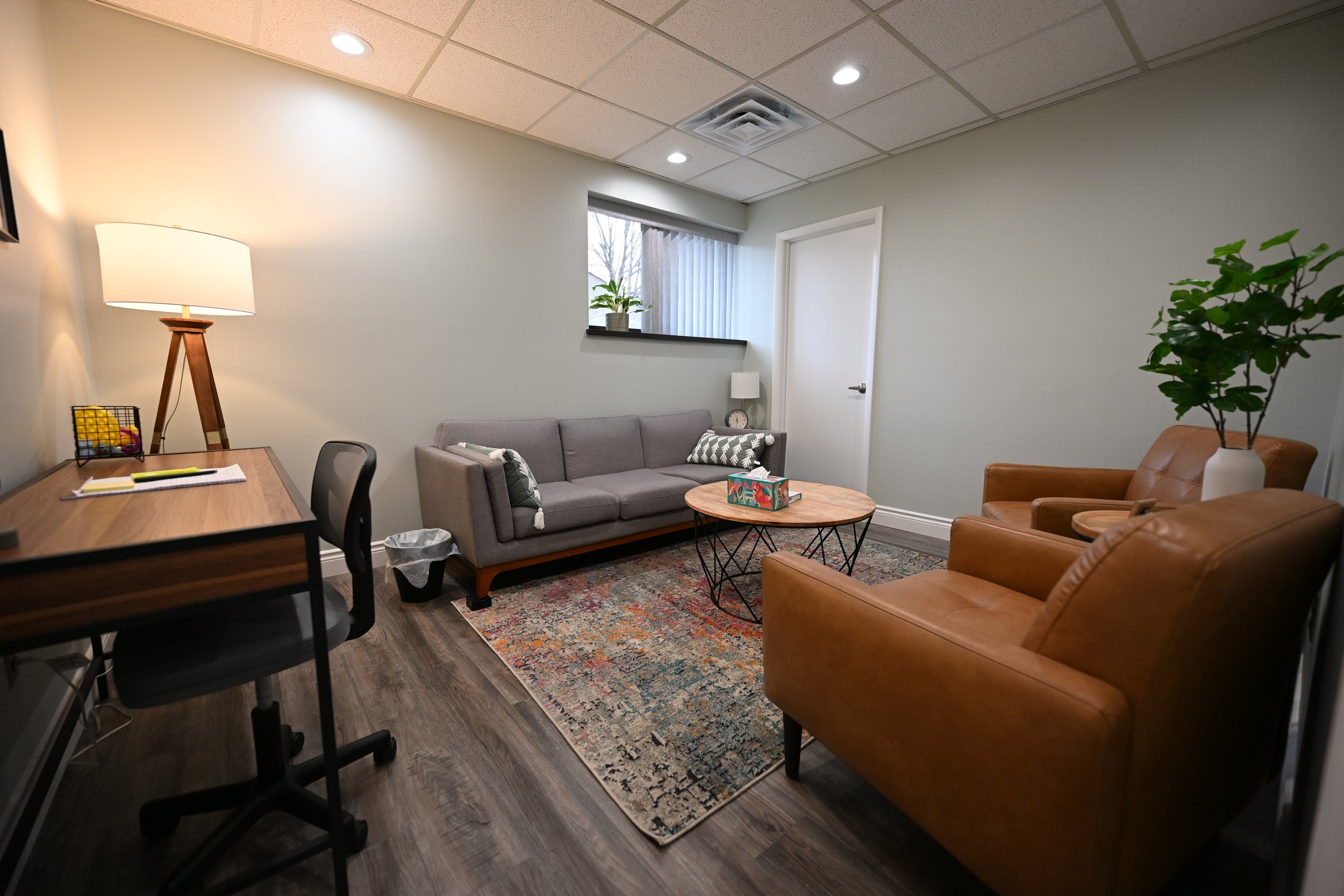
To choose the ideal treatment room for rent without overpaying, prioritize flexible hourly or shift-based rental models that align with your caseload, verify robust acoustic insulation for client privacy, and ensure essential utilities and amenities are bundled into a clear rate. Balancing practical geographic accessibility with a calming clinical atmosphere allows you to build a sustainable, professional practice.
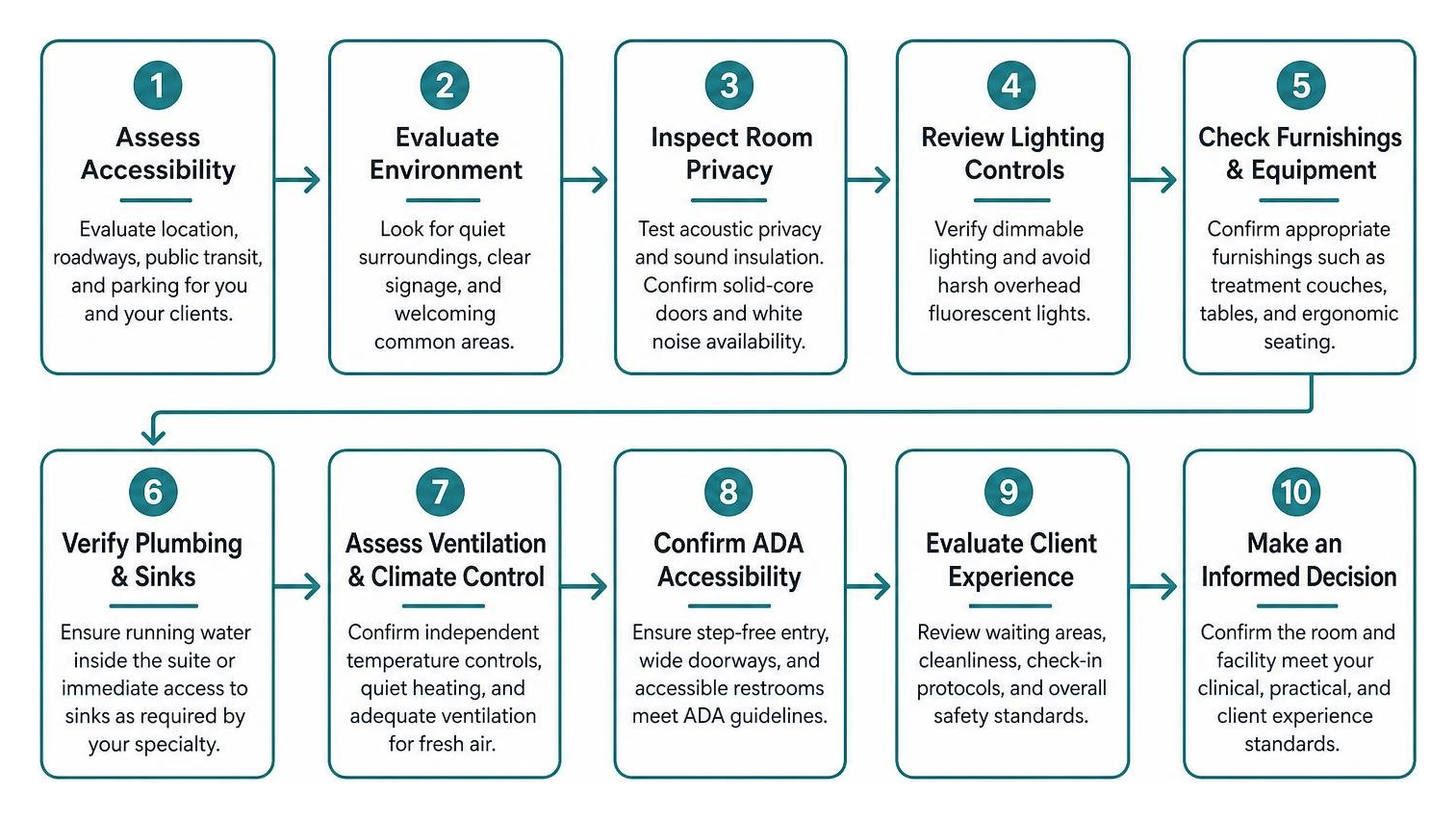
Begin by assessing accessibility for both you and your clients. Is the facility easy to reach via major roadways and public transit? Are there dedicated parking facilities, or will your clients have to navigate stressful street parking before their appointments? A serene experience begins before a client ever steps into your office. Look for quiet surroundings, clear entryway signage, and welcoming common areas.
To make your search straightforward, we design our Rentable Therapy Space options to eliminate the friction of launching or scaling a private mental health practice.
How to Inspect a Treatment Room for Rent Before Signing
Before committing to any rental agreement, an on-site visit is critical. You need to verify that the physical room meets the practical and confidential requirements of your specific modality.
Use this checklist during your walkthrough:
- Acoustic privacy and sound insulation: Confidentiality is paramount. Test sound transfer between rooms by having a colleague speak at normal conversation levels in the hallway while you stand inside with the door closed. Check for acoustic wall panels, solid-core doors, and white noise machines outside consultation rooms.
- Lighting controls: Look for dimmable lighting systems. Harsh overhead fluorescent lights can trigger anxiety or sensory discomfort, whereas warm, adjustable accent lighting creates a calming therapeutic atmosphere.
- Specialized furnishings: If your work requires hands-on care, verify whether the room includes an electric treatment couch, hydraulic tables, or adjustable practitioner stools. For mental health counselors, inspect the seating ergonomics to ensure long-term comfort during back-to-back sessions.
- Plumbing and dedicated sinks: Depending on your specialty, having running water inside the treatment suite or immediate access in an adjacent corridor may be required by professional hygiene standards.
- Ventilation and climate control: Check that the room has independent temperature controls, quiet central heating, and adequate ventilation to maintain fresh air throughout the day.
Location, Accessibility, and Client Experience
A prime location provides credibility and convenience. When clients arrive, the building’s curb appeal and interior presentation reflect directly on your standard of care.
Prioritize spaces that adhere strictly to Americans with Disabilities Act (ADA) accessibility guidelines, including step-free building entries, wide doorways, and accessible restrooms. Client waiting areas should be clean, quiet, and professionally maintained, giving visitors a restful place to sit before their appointment. Having clear check-in protocols and safety standards throughout the building ensures your clients feel secure from the moment they arrive.
Breaking Down Rental Pricing and Agreement Models
Navigating commercial rental agreements can be confusing. Traditional property managers often lock tenants into rigid multi-year agreements, but modern shared suites offer dynamic, flexible pricing structures designed to scale alongside your client roster.

Understanding the distinctions between rental models will prevent you from overpaying for unused hours while your caseload develops:
| Rental Model | Typical Commitment | Best Suited For | Key Advantages |
|---|---|---|---|
| Ad-Hoc Hourly | 1-hour increments | Starting out, telehealth hybrid, supplemental caseload | Zero ongoing commitment; pay only for scheduled client hours |
| Half-Day Shift | 5.5-hour block (e.g., morning/afternoon) | Established part-time caseload (8–15 clients/week) | Lower effective hourly rate; consistent weekly schedule |
| Full-Day Shift | 8-hour block (e.g., 9:00am–5:00pm) | Full-time practitioner concentrating clients into set days | Significant bulk discount; uninterrupted room access |
| Committed License / Monthly | Month-to-month or multi-month recurring | Full-time solo practitioners requiring dedicated space | Lowest per-hour cost; permanent business presence; flat-rate predictability |
Hourly Rates, Half-Day Shifts, and Monthly Leases
Many practitioners begin with ad-hoc hourly rentals. This model gives you complete scheduling autonomy, allowing you to book rooms only when you have confirmed appointments on your calendar. Some providers introduce off-peak pricing tiers, offering discounted rates for morning slots to help you optimize operating costs.
As your client base expands, transitioning to shift blocks—such as a 5.5-hour half-shift or an 8-hour full-shift—dramatically lowers your average hourly overhead. Committed monthly licenses offer an even deeper discount, sometimes reducing effective hourly costs while giving you recurring, guaranteed access to your preferred suite.
Budgeting for Your First Treatment Room for Rent
When calculating your operating budget, look beyond the base rental figure to identify potential hidden fees.
Take into account:
- Security deposits: Determine whether the facility requires a refundable security deposit or upfront registration fee.
- Included utilities: Confirm that high-speed fiber internet, heating, air conditioning, water, and trash removal are bundled into the quoted rate.
- Janitorial and cleaning services: Daily professional sanitation of shared restrooms, waiting lounges, and common corridors should be standard.
- Consumable supplies: Clarify whether items like paper rolls, sanitizing wipes, hand towels, and waiting room refreshments are provided or must be supplied by the practitioner.
Essential Amenities, Compliance, and Insurance Checklist
A fully managed, turn-key treatment room should simplify your administrative routine, allowing you to focus entirely on client care rather than facility maintenance.

High-value shared facilities bundle essential operational amenities directly into their membership plans, including:
- High-speed business Wi-Fi with secure network separation
- Staff breakrooms with refrigerators, microwaves, and coffee stations
- Professional mail handling and a dedicated business address
- On-site laundry facilities for treatment linens
- Secure client entry systems and clean, quiet waiting rooms
If you are curious about how these amenities are managed day-to-day, our FAQ provides clear answers on operational guidelines, access hours, and suite policies.
Soundproofing, Cleanliness, and Furniture Standards
In mental health therapy, privacy is not a luxury—it is a compliance necessity. Meeting Health Insurance Portability and Accountability Act (HIPAA) standards requires rigorous attention to acoustic insulation. Look for rooms designed with sound-dampening drywall, insulated doors, and perimeter acoustic seals.
Cleanliness protocols should be clearly defined. Shared spaces require reliable sanitation schedules, medical-grade waste disposal where applicable, and high-durability, easy-to-sanitize furniture. High-quality ergonomic seating and adaptable furniture ensure that both you and your clients remain comfortable throughout extended consultations.
Liability Insurance, Malpractice, and Accreditations
Every reputable shared wellness facility enforces strict compliance standards to protect all practitioners and clients in the community.
Before signing a rental agreement, ensure you have the following credentials ready:
- General Liability Insurance: Most professional facilities require tenants to hold commercial general liability coverage with a minimum limit of $1,000,000 per occurrence.
- Professional Malpractice/Indemnity Coverage: Proof of active professional liability insurance specific to your clinical scope of practice.
- State Licensure: An active, unencumbered license issued by your state licensing board (e.g., LPC, LMFT, LCSW, PsyD).
- Identification & Documentation: Government-issued photo ID and current professional credentials.
How Shared Treatment Spaces Benefit Independent Practices
Transitioning to a shared suite environment gives solo practitioners the prestige and functionality of a private medical clinic without the associated administrative burdens.
Ready to leave behind administrative stress and join a supportive workspace? You can Join Now to secure a flexible room package tailored to your current caseload.
Comparing Private Commercial Leases to Shared Wellness Suites
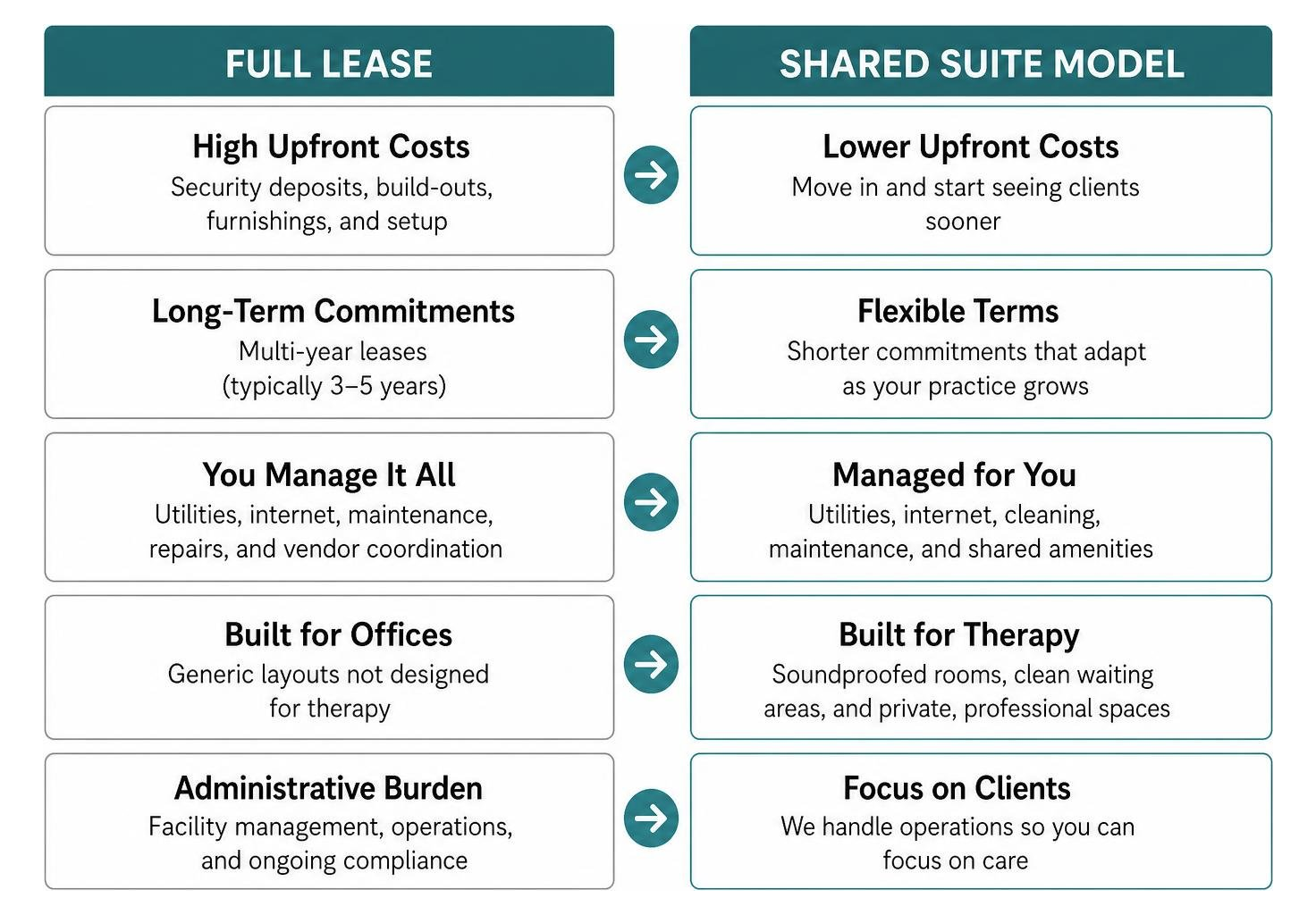
A traditional commercial office lease requires substantial capital expenditure. Tenants are typically responsible for multi-year lease commitments (often 3 to 5 years), significant security deposits, expensive architectural build-outs, acoustic treatments, office furnishings, utility accounts, and ongoing maintenance fees.
In contrast, shared treatment suites offer a plug-and-play alternative. You bypass build-out costs, avoid long-term debt, and retain the flexibility to scale your hours up or down based on your evolving business requirements.
Networking Opportunities and Inter-Practitioner Referrals
Working in a shared professional facility combats the isolation often experienced by solo practitioners. When you share a professional home with mental health counselors, holistic wellness specialists, and other healthcare professionals, organic referral networks develop naturally.
To see the diverse community of practitioners working alongside one another, explore our directory of Members at Therasuites Livonia to see how multi-disciplinary collaboration enriches independent practices.
Frequently Asked Questions About Treatment Rooms
What types of practitioners typically rent treatment rooms?
Shared treatment suites accommodate a wide range of licensed professionals, including:
- Mental health therapists, psychologists, and clinical social workers
- Massage therapists, craniosacral specialists, and bodyworkers
- Acupuncturists and holistic wellness consultants
- Estheticians, lash technicians, and permanent makeup artists
- Nurse practitioners, medical injectors, and wellness coaches
What are standard cancellation policies for room bookings?
Most flexible rental platforms implement a 24- to 48-hour cancellation notice window for ad-hoc hourly bookings. Providing notice outside this window typically issues a full booking credit back to your account. Recurring monthly shift agreements generally operate on a 30-day written cancellation notice, providing stability while avoiding multi-year locks.
Are flexible part-time shifts suitable for new practitioners?
Yes. Part-time shift blocks (such as two half-shifts or one full day per week) are ideal for clinicians transitioning from agency work or group practices into solo business ownership. This approach allows you to bootstrap your business with minimal overhead, scaling up your room commitments as your client schedule fills.
Conclusion
Overpaying for office space you only use part of the week drains your practice's revenue and creates unnecessary stress. By choosing a turnkey, flexible treatment suite, you gain access to premium clinical furnishings, acoustic privacy, business support amenities, and a collaborative professional community—all while keeping your overhead low.
Take control of your practice's financial health today. Explore our customizable memberships and discover flexible, beautifully appointed treatment spaces at TheraSuites.